Phytoplankton and pigments
Measures chlorophyll-a from 0.01 to 1000 mg·m⁻³ and distinguishes pigment returns associated with phycoerythrin and phycocyanin
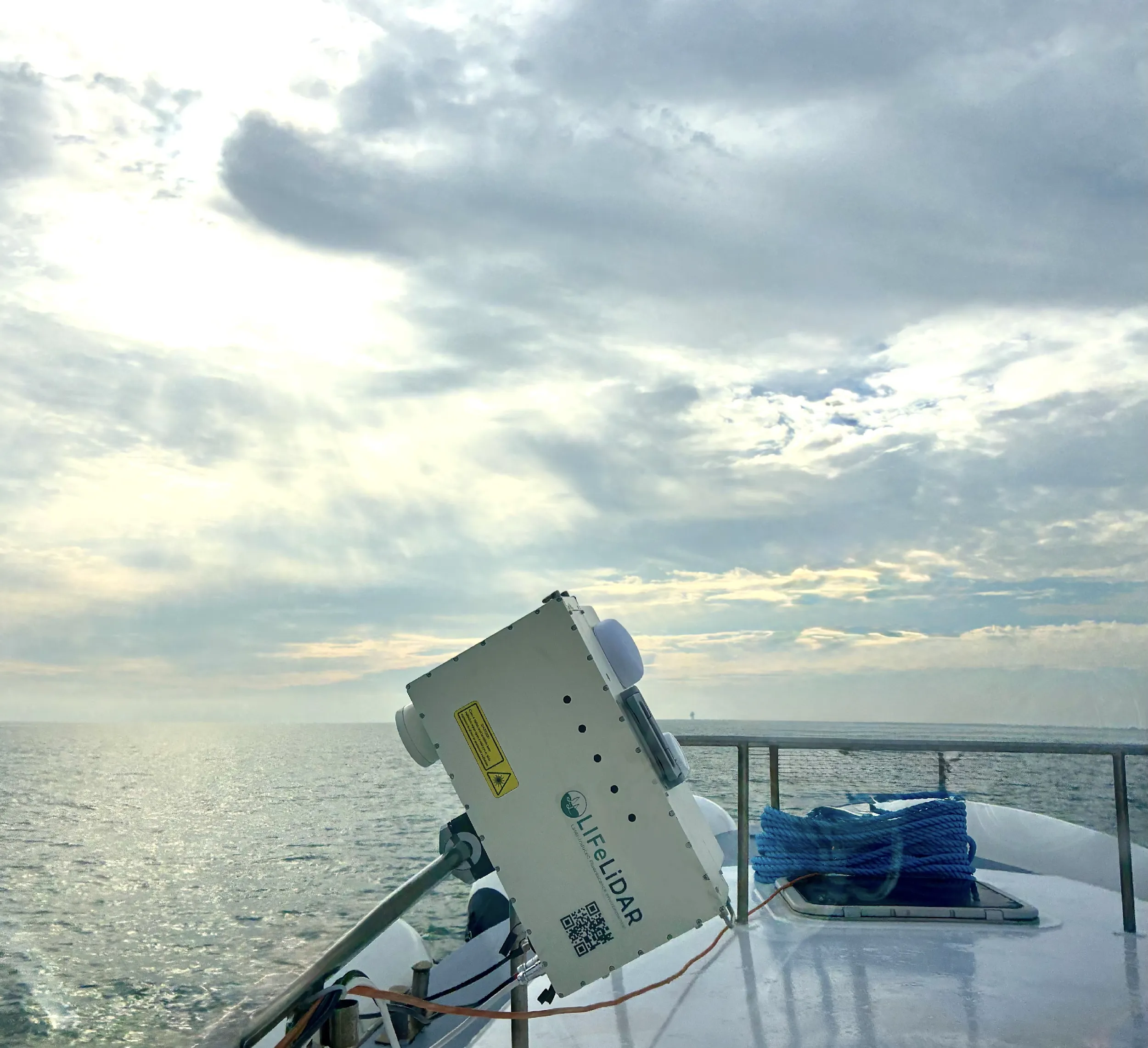
Multi-wavelength water-quality surveys from vessels and small aircraft
The LIFL-11 combines laser-induced fluorescence, elastic scattering, and Raman scattering in one survey instrument. It records the full 48-band return in about fifteen seconds at a station or measures four selected bands at up to 10 Hz while underway. Two excitation configurations cover chlorophyll, CDOM, suspended matter, oils, phenols, and tryptophan.
A simplified external model that can be rotated by hand
Enable JavaScript to inspect the three-dimensional instrument model
Drag to turn the instrument
The receiver separates each reported parameter by its optical process and its position in the return spectrum
Measures chlorophyll-a from 0.01 to 1000 mg·m⁻³ and distinguishes pigment returns associated with phycoerythrin and phycocyanin
Characterises CDOM and FDOM, including fulvic and humic matter and optical markers associated with wastewater
Uses 266 nm excitation to distinguish fluorescence from fuels, diesel, crude oil, and oil-in-water emulsions
Records fluorescence signatures from polyethylene, polypropylene, wood, leaves, seagrass, and surface foam
Maps mineral particles and suspended sediment from 0.1 to 1000 g·m⁻³ along the survey track
The 48-band record also contains returns associated with phycoerythrin, phycocyanin, bacteriochlorophyll, tryptophan, phenol markers, and methane seeps
Mounting and integration are specified for the instrument and survey method
Fixed deck or rail mount
Continuous transects or station workCompact rail installation
Shallow-water and nearshore surveysFixed vessel installation
Repeated routes with vessel crewSmall-aircraft payload
Airborne transect measurementsPermanent above-water installation
Long-term monitoring in exposed conditionsDeck-mounted payload
Uncrewed transect measurementsThe engineering team handles quotations, mounting requirements, and integration questions