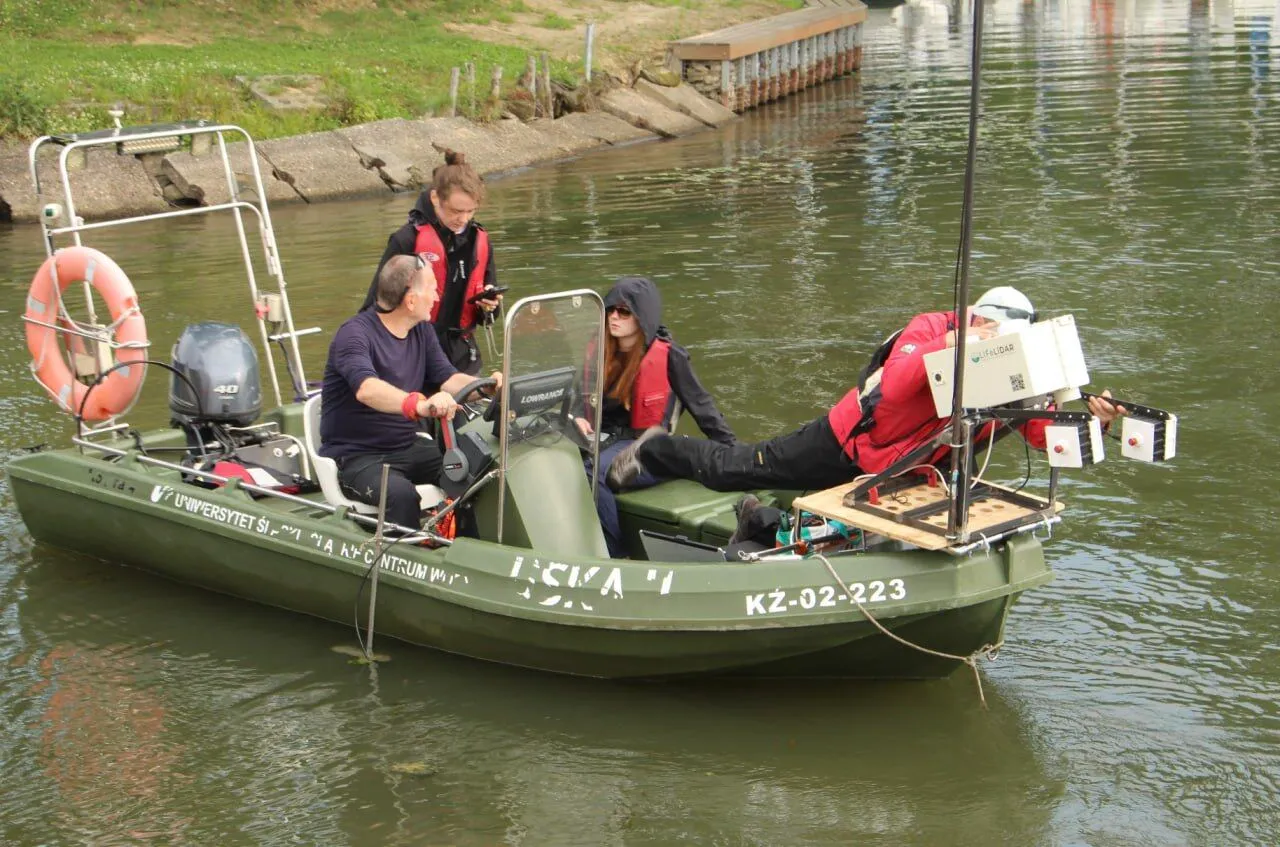
From 16 to 19 June, the team completed four survey days on Goczałkowice Reservoir in southern Poland with the University of Warsaw and the University of Silesia in Katowice. The reservoir is a principal source of drinking water for the Upper Silesian conurbation.
The instrument suite comprised one LIFL-11, two mFL-12 lidars, and an mHR-2 radiometer. While the vessel was underway, the LIFL-11 profiled the water column and recorded surface fluorescence using 355 and 532 nm excitation. More than 130,000 surface measurements were collected across the four days, providing relative chlorophyll-a and CDOM fields for the reservoir.
Conventional samples were taken throughout the campaign, and two autonomous buoys were towed beside the vessel to record additional water parameters. These observations provide the reference set for evaluating the lidar maps along the same track.
On the final day, the team sampled Farskie, a small lake near Gliwice, as part of an investigation into golden algae. Laboratory analysis is required before the presence or absence of the organism can be established.
We thank the University of Warsaw, the University of Silesia in Katowice, Iwona Stachlewska, and Mariola Krodkiewska for the collaboration.